Calculate your cost savings
TACNA 619.661.1261

A Look at Mexico’s Cosmetics Industry

Still reeling from the impact of the 2020 crisis, Mexico’s cosmetics industry is nonetheless making a recovery. The sector is firmly entrenched in the Latin American country. And signs point to future growth. 

Mexico’s cosmetics industry

Mexico offers a diverse blend of specialties, technologies, and sub-sectors relating to beauty products and cosmetics production. The manufacture of these products supports a robust domestic market as well as a growing export market abroad. 

Cosmetic Industry in Mexico

The cosmetics industry is considered a best prospect industry sector by Export.gov. Due to growing domestic demand and expanding global access, Mexico is the 2nd largest market for cosmetics in Latin America and is among the top 10 in the world.  In 2019 alone, Mexico imported about $1.3 billion USD of beauty and personal care products. But with more than $570 million USD worth of exports, Mexico is also the world’s 5th largest cosmetics exporter.

Mexico’s cosmetics industry is a mature one, with numerous sub sectors like:

Skin Care

Approximately 20% of the personal care market is devoted to skin care products to help consumers avoid or repair solar damage, maintain youthful skin from a young age, and to cultivate a well-groomed look. This latter emphasis has greatly expanded the market for men.

Hair Care

Also representing 20% of the overall market, this sub-sector greatly benefits from targeting men – their beards, particularly. Extensions among women have also become a popular Mexican cosmetic product.

Fragrances

Representing approximately 14% of the market, this sub-sector is growing in popularity. Online retailers like Amazon Mexico and Mercado Libre have made perfumes and body splashes a very profitable segment for Mexican cosmetic producers. 

Makeup/Nails

15% of Mexico’s cosmetics industry is comprised of makeup and nails and related accessories. These are marketed directly to the domestic market primarily through local retailers. 

Major Cometic Brands in Mexico

Mexico’s domestic consumer market has greatly expanded due to free trade relationships with over 50 nations. Brands from Europe, Asia, and South America remain popular there, in addition to Mexican-based brands. 

Some of the largest cosmetics brands in the world invest millions of dollars annually into Mexican research and development facilities for the creation of new beauty products. Some of these heavy hitters include the following:

  • L’Oreal invested more than $25 million USD in 2017 alone.
  • Avon invested about $2.6 million USD in 2017.
  • Estée Lauder invested nearly $9 million USD.
  • Mary Kay has invested extensively in Mexico and currently owns about 18% of the Mexican market.

Many others of the world’s largest multinational cosmetics companies operate distribution and manufacturing facilities in Mexico. Some of these major cosmetics manufactures and retailers doing business in Mexico include:

  • Revlon
  • Sephora
  • Procter & Gamble
  • Unilever
  • Beiersdorf

Road to Recovery

The 2020 crisis was a real blow to Mexico’s cosmetics industry. In that year, the industry reported a 5.3% contraction. However, this was better than the total global contraction of 8% felt by the world cosmetics industry that year. And in spite of mass store closures by major cosmetics and personal care retailers, these same stores have adapted to online shopping. Demand for Mexico’s personal care products is climbing post-COVID, too.

And in 2021, Unilever doubled down on their Mexico investment with a 3-year plan to invest an additional $277 million USD to increase production at their four Mexican plants. This greater production is aimed at increasing exports out of Mexico for the company.  

In addition to the United States – a top trading partner – Mexico exports cosmetics products to around 100 other nations. It is this diversified export base, coupled with a strong and growing domestic base, that will help Mexico recover from the recent contraction and continue to exceed pre-COVID numbers. 

According to recent projections, Mexico’s beauty and personal care market will grow at 3.53% CAGR 2022-2026. 11.8% of that increased revenue will come from online shopping. Mexico’s cosmetics industry has taken a hit. But through renewed investment from global stakeholders and increased innovation and adaptation, the market is set for sustained growth in the near future.
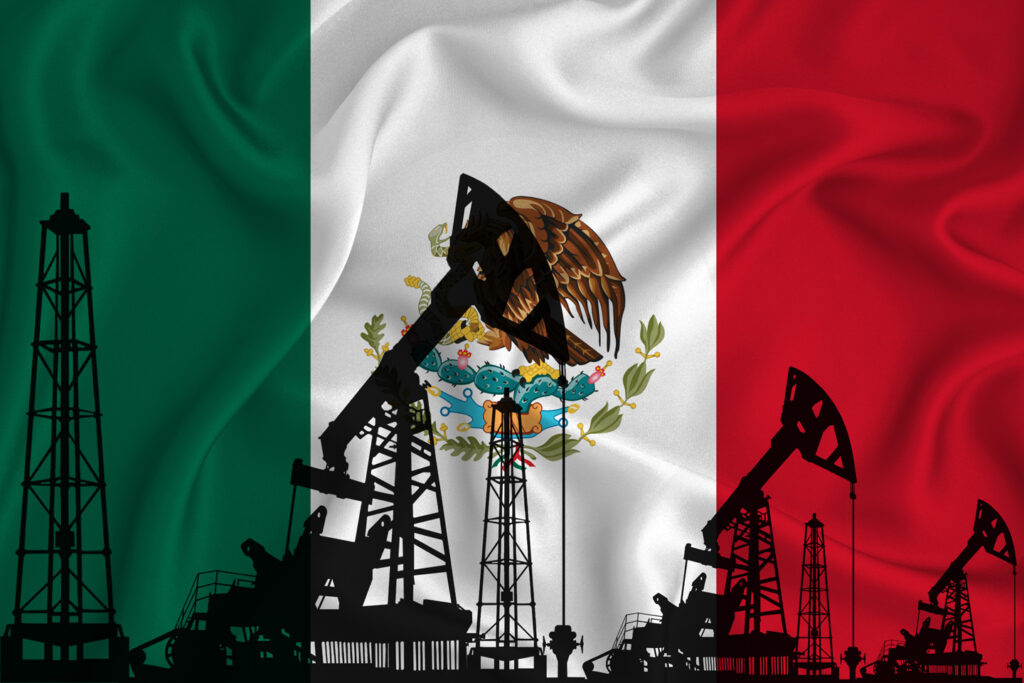

Spotlight on Mexican Oil and Gas

As the global fuel supply crisis continues and gasoline prices spike, the subject of Mexican oil and gas is often brought up. Mexico has vast potential and a long history of involvement in the global petroleum market. 

Mexican oil and gas

But their situation is a complicated one. Political pressures have frustrated attempts to sufficiently leverage Mexico’s petroleum. Yet Mexico remains one of the richest sources in the world for petroleum products. Below is a look at the Mexican oil and gas industry, its potential, and its challenges.

The Potential

Mexico’s economy depends on oil and gas for a large share of its activity. So much of the economic activity in Mexico is either directly or indirectly related to its petroleum. An estimated 58% of Mexico’s federal government revenue comes from this industry. Mexican oil and gas has incredible potential. And this potential, while not yet fully exploited, is already paying great dividends to the Mexican people. 

In fact, while Mexico is fighting to curb inflation like most developed countries, President Andres Manuel Lopez Obrador recently announced a plan to use the nation’s petroleum to help. Since the beginning of 2022, Mexico has been subsidizing gasoline and diesel to curb rising prices and combat inflation. The source for these subsidies? The rising sale prices on exported crude.

Mexico exports approximately one million barrels a day. And because the price of crude has risen much higher than the $55/barrel they anticipated in the national budget for 2022, the Obrador administration is diverting this windfall to the consumer to offset rising gasoline prices at the pump. So far, the subsidies have cost the nation about $4.4 billion USD – approximately half of their oil revenue received so far this year.

By the Numbers

Mexico is one of the largest oil producers globally. Indeed, Mexican oil and gas as an industry ranks among the highest in the world. This is evidenced by the following statistics:

  • Mexico produced 1.9 billion barrels of oil per day in 2020.
  • The country is the 4th largest oil producer in the west and 13th in the world.
  • Refined capacity is ranked 16th.
  • Logistics infrastructure is 5th in the world.
  • Mexico exported 240 million barrels of crude to the US in 2020.
  • The country has the 17th largest reserve of oil, at 9.71 million barrels.
  • Mexico has proven reserves equivalent to 13 years of annual consumption at current rates.
  • Mexico exports 50% of its oil production.
  • More than 10% of Mexico’s export earnings come from oil production.
  • Mexico has approximately 17 trillion cubic feet of proven natural gas reserves.

Challenges to Mexican Oil and Gas

In spite of Mexico’s vast wealth and economic activity in the oil and gas sector, the country could be doing so much more. But the country’s history of exploration and regulation is fraught with setbacks and reversals. 

For much of Mexico’s recent history, the country’s oil and gas industry was entirely shut off to private enterprise, foreign or domestic. In 1938, all oil resources were nationalized under the newly created, state-owned company, Pemex. Over the next several decades, oil output expanded by about 6% annually on average, and numerous fields were discovered. In 1983, Mexico’s proven hydrocarbon reserves had expanded to 72.5 billion barrels. By 2007, Mexico was exporting a net of 1.8 million barrels per day. Yet foreign investment was not allowed to multiply this latent potential.

However, things began to change in 2012 with incoming President Peña Nieto. Energy reform was one of his major campaign promises, and in 2014, the Mexican Congress approved the president’s plan to re-open Mexican oil and gas to private and foreign investment. But the first rounds of bidding on oil exploration contracts didn’t generate as much activity as hoped. And in spite of some private wells and contracts, Mexico has largely closed the oil industry back down. 

Current President Obrador immediately suspended bid rounds upon taking office. He has since enacted regulatory changes to greatly hinder private sector involvement, particularly in midstream and downstream. In 2021, the Mexican Congress gave the federal government greater authority to suspend existing permits. 

The Future of Mexican Oil and Gas

Currently, the country is pushing for greater energy independence. The country is expanding refinery capacity and seeking to phase out all exports in the next few years. This plan rests on the ability to increase crude production. But with private investment all but shut out, this seems unlikely. And the country currently sources approximately 90% of its natural gas from other countries (76% from the US alone). 

There are opportunities for Pemex to better exploit Mexico’s potential in this sector. Their plan for the next five years is an ambitious one, with 399 new projects listed for shallow water, deep water, and on shore. They aim to upgrade 25 platforms, install pipelines connecting ports in Veracruz to ports in Oaxaca, and install eight interconnections for the existing shallow water platforms in the Gulf of Mexico.

There are also measures in place to open up the upstream market to foreign investment. This should attract US suppliers and greater foreign investment. But how this actually plays out remains to be seen.

Manufacturing Resilience in a Recession

With all the uncertainty and negative market signals in the news, Americans are beginning to wonder if a recession is just around the corner. And if it is, the first question that should be on the minds of those engaged in manufacturing is how exactly they can build resilience in a recession. 

resilience in a recession

History shows periods of economic downturn can create significant opportunity for future growth and improvement. But some manufacturers suffer and even file bankruptcy due to economic downturns. What makes the difference?

Why are some manufactures able to better weather the storm and demonstrate profound resilience in a recession while other companies are devastated? There are key insights to observe from past recessions that show us how to prepare for the next economic crisis, whenever that may be.

There’s a Storm on the Horizon

After the brief, COVID-induced mini-recession in early 2020, the US embarked on a 6-quarter period of strong growth. The past year has been a surprisingly active time of growth for US manufacturers. Consumer spending has been strong, in spite of supply-chain crises and shortages.

However, in the last quarter, US gross domestic product (GDP) slipped about 1.4%. This was the first sign that a recession could be on the horizon.  But it’s far from the only sign. 

A recession is typically defined as a period of two consecutive quarters of negative economic growth. And for this reason, it can be hard to determine if a recession has begun until it has been underway for six months. But there are key red flags to signal such an impending storm. 

  • Typically, high inflation is a concerning sign. Last March, consumer prices rose year over year 8.5% – the highest hike in 40 years. In May, the year over year increase was 8.3%.
  • A negative yield curve is another red flag. Over the past few months, the yield curve has flattened and briefly dipped negative in April. This signals waning confidence in the US economy on the part of bond investors.
  • Geopolitical uncertainty is the third hallmark of a potential recession developing. Of course, the war in Ukraine and the ensuing food and energy shortages easily check this box.

Recessions and Manufacturing

Historically, recessions have impacted the durable goods sector harder than non-durable goods. In other words, industrial manufacturing tends to be the hardest hit in times of economic hardship. In fact, during the Great Recession of 2008, 40% of the companies that filed for bankruptcy were from industrial manufacturing. On the other hand, nondurables and service industries are impacted least, because consumers cannot necessarily forego purchasing health services, groceries, etc. 

But conversely, while manufacturing is usually the first to suffer from a downturn, this sector also tends to rebound the soonest. In fact, in the post-recession periods following the 2001 and 2008 recessions, industrial manufacturers experienced recovery in corporate profits three times higher than nondurables and services companies. Therefore, manufacturers should look for ways to build resilience in a recession to take advantage of increased business opportunities in the upswing.

Strategies to Build Resilience in a Recession

Two key factors clearly influence resilience in a recession for manufacturers, based on previous recoveries: cash liquidity and technological investment pre-recession. In brief, manufacturers who maintained a healthy cashflow and actually increased capital investments heading into the downturn significantly outperformed manufacturers who were overleveraged and pulled back in response to red flags.

Cash Liquidity

In previous recoveries, manufacturers with relatively low debts and higher interest coverage demonstrated far more resilience during the recession and significantly higher revenue growth in the 5-year recovery period following. 

However, companies should not focus entirely on cash on their balance sheets, as this is may not provide the same level of insight needed to closely control cash on hand. Absolute liquidity is determined by more direct methods of cashflow management, such as direct cashflow modeling. 

This approach covers major factors affecting weekly cashflow in coordination with high-level assumptions about unpredictable and less material areas of real cashflow. This way, manufacturers can better manage current debt levels and improve working capital. In turn businesses will be better positioned to strategically maneuver in times of stress and uncertainty.

Targeted Capital Investment

Manufacturing is an asset-heavy business. As such, companies need a constant influx of capital investment to improve productivity and lower costs. Research shows that in the 2001 and 2008 recessions, those manufacturers who increased targeted investment in the 5-year period leading up to the downturn realized much higher revenue recovery in the 5-year period following the downturn because of it.

Investing in lean manufacturing and automation technology and processes can mean the difference between surviving a recession and thriving in a recession. In the next 12 months, to ensure resilience in a future recession, manufacturers should increase technology investment, particularly in digital. 

And when it comes to digital, process-related innovations are generally more rewarding than product-based and customer-based innovations. They also reduce costs through output and inventory optimization. Indeed, digitalization has proven a key factor in manufacturing competitiveness in an economic crisis. Digital can lead to new product offerings and more efficient operations, thus increasing agility and the bottom line.

China’s Zero COVID Policy Devastating Industry

Since the COVID scare of 2020, most of the world has rebounded economically. But China’s Zero COVID policy has created lasting problems for the country’s productive output and economic outlook. Many European and American companies are reconsidering their investment there. Draconian health measures are becoming a routine part of life now, and the endless cycle of lockdowns and shutdowns are making economic growth virtually impossible to achieve in the world’s largest manufacturing nation. 

China’s Zero COVID

China’s Zero COVID Policy

In spite of mounting negative economic signals and discontent among its citizens, China is doubling down on its goal of achieving zero cases of COVID in the country of 1.4 billion people.  Whereas proclamations and speeches out of Beijing once spoke of balancing health goals with economic growth, in recent months the national government has pivoted to strongly condemning any form of dissent or grumbling. As wave after wave of crackdowns crush the once mighty economy, the government is now calling on unswerving commitment and absolute unity in enforcing these measures regardless of the cost.

Entire neighborhoods are routinely sealed off across the country. Mass testing is enforced. Citizens are often forced to surrender the keys to their homes to government for disinfecting, even if they have tested negative for the Coronavirus. Lockdowns are targeted and very strict. Last March, Shanghai locked down all 25 million of its residents, banning them from leaving their homes except for medical emergencies. 

Some neighborhoods or individual residents often receive notice that they are not allowed to leave their homes or even receive deliveries until further notice. Essential medical treatments are delayed. Families are separated over positive tests. And work-from-home is mandatory in many regions of the country at varying times.

The seemingly random and unpredictable nature of these measures has left the public increasingly frustrated that they will never end. There is growing sentiment that the country will never be allowed to return to work or some form of normalcy. Videos continue to pop up in Western social media after being banned from the Chinese internet of citizens arguing with health officials, banging pots and pans together in displays of discontent, and begging for basic medical necessities. 

Economic Growth Outlook

As a result of these repeated lockdowns and disruptions, the economic outlook for Chinese industry is quite bleak. In spite of a formerly robust manufacturing sector, the productive output of China is on the decline. In addition to rising wages, materials costs in China are rapidly rising, leading some to theorize that China’s Zero COVID policy is significantly jeopardizing their manufacturing industry

In spite of a mild recovery after the recession of 2020, China is entering a new period of contraction that may prove much worse. And this time, the manufacturing giant seems ill prepared to dig itself out. Nearly all numbers coming out of China’s economy are negative:

A Manufacturing Exodus Coming?

China’s Zero COVID measures have no doubt created growing interest in relocating manufacturing operations in other countries. News recently broke that one of China’s largest manufacturing partners, Apple, is considering expansion outside China

The tech giant manufacturers approximately 90% of its products in China via contract manufacturing. However, Apple cited China’s Zero COVID policies as a critical motivation in considering other manufacturing locations. Apple suppliers like Foxconn and Quanta Computer have been repeatedly shut down for COVID cases and minor outbreaks. In spite of aggressive preventative systems to combat the spread of the virus, these factories frequently grind to a halt due to government restrictions. Apple CEO, Tim Cook, recently estimated COVID-related supply chain restraints in the country between $4 billion and 8 billion USD for the current quarter.

In combination with dramatically rising labor and transportation costs for Chinese manufacturers in recent years, these new obstacles make relocation highly desirable. However, relocating entire manufacturing operations and supply-chain networks is no small feat. There are considerable challenges to relocating a supply chain from China. China offers extensive vendor networks, very high scales of volume, and highly integrated supply chains. But these advantages come at a cost. For example, Chinese companies typically claim ownership to proprietary schematics, design specifications, drawings, and even tooling. Transfer of capital must navigate complicated and difficult rules. 

Nevertheless, companies like Apple and other manufacturing leaders are considering a future beyond Chinese manufacturing. While other Southeast Asian locations are popular alternatives, one alternative growing in popularity is Mexico. In addition to considerably lower costs than China, Mexico also has much lighter COVID restrictions

And in the midst of global disruptions and shortages, competitive manufacturers will seek out safe havens for consistency and predictable cost savings. In spite of the government doubling down on it, China’s Zero COVID policy may play a leading role in handicapping future growth for the country.

Understanding Mexican Workplace Culture

While Mexico is separated from US workplaces by only a single border, there are several notable differences with Mexican workplace culture.  US companies doing business in Mexico may be caught off guard by Mexican norms, customs, or regulations dissimilar to those in the United States. 

Mexican workplace culture

For this reason, it is advantageous for US executives to thoroughly understand the way Mexicans conduct business in their offices and factories. Mexican workplace culture, while in many ways different from that in the US, also has many similarities. Taking the time to appreciate these contrasts will afford the US manager an advantage in Mexico. 

The 48-Hour Work Week

While the Mexican workday is typically eight hours just like that of the US, the work week is actually more like 48 hours. Mexican workers usually stay later than the prescribed working hours, as it is considered rude to leave promptly at “quitting time.” But generally speaking:

  • The day shift is approximately eight hours between 6:00 am and 8:00 pm, with a total 48-hour work week.
  • The night shift is approximately seven hours between 8:00 pm and 6:00 am, with a total 42-hour work week.
  • The mixed shift is approximately seven and a half hours spread between the two other shifts, with a total 45-hour work week.

Vacation Time

In spite of a generally longer work week, Mexican workplace culture affords a strong vacation regimen and paid holidays to balance it out. For the first year of employment, employers are not required to give any special vacation time off. But after this, federally required paid vacation days number:

  • 1 year: 6 vacation days
  • 2 years: 8 vacation days
  • 3 years: 10 vacation days
  • 4 years: 12 vacation days
  • 5-9 years: 14 vacation days
  • 10-14 years: 16 vacation days
  • 15-19 years: 18 vacation days
  • 20-24 years: 20 vacation days
  • 25-29 years: 22 vacation days

In addition to being paid at the usual salary for these vacation days, employees are also given an additional 25% vacation premium. This is also true for all national holidays, which are required by national labor laws. The following are required paid holidays:

  • New Year’s Day: January 1
  • Constitution Day: 1st Monday in February
  • Benito Juarez’s Birthday: 3rd Monday in March
  • Maundy Thursday: the Thursday before Easter
  • Good Friday: March/April
  • Labor Day: May 1
  • Independence Day: September 16
  • Revolution Day: 3rd Monday of November
  • Christmas Day: December 25

Business Etiquette

When travelling or doing business in Mexico, it pays to understand how your Mexican counterparts expect you to behave. There are several notable differences between usual Mexican workplace culture and usual US business culture. Here are a few of the most notable:

Hierarchy

Mexicans are still divided to an extent by social classes and very socially conscious. At business meetings, be sure to bring comparable seniority to match their executives. Address people using their full names and proper titles. In the factory or office, do not expect lower-level workers to have the authority or vested interest to make promises or input above their pay grade.

Time

Time is more fluid and flexible in Mexican workplace culture. While arriving to work or meetings on time, it is not uncommon for people to be 15-30 minutes late. However, it is also customary to stay late by at least half an hour. “Mañana” may mean tomorrow, but more often it just means sometime in the near future. “Ahorita” may mean right now, but again, it usually just means soon.

Business Meals

Mexicans love work lunches. But theirs are very different from those in the US. Expect this to be the primary meal of the day and for very little business to be accomplished. This is the whole point. Mexicans want to know their business associates well. Relax, prepare for a lot of small talk and personal sharing. “La comida” typically lasts from 12:00 to 2:00 pm. 

Formality

Email communications, even with long-time colleagues, use highly polite and formal language. Yet, expect meetings and interactions to often incorporate emotional language and displays. This shows commitment and involvement, not a lack of control.

Compensation Norms

  • Regardless of what their rank is, Mexican workers are entitled to double pay on any overtime worked. 
  • Sick pay is 60% of their usual pay for up to 52 weeks after an injury or illness, covered by social security.
  • Maternity pay is 100% of usual pay for 12 weeks, covered by social security.
  • Paternity is also full pay for five days, covered by social security.
  • The “Aguinaldo” or Christmas bonus is paid on December 20th and is equal to 15 days salary.
  • Companies are required to share 10% of their profits with non-first-year employees. Profit, however, for maquiladoras is a cost-based calculation of the manufacturing operation.
  • Car allowances are not customary. 
  • Employees terminated “without cause” are entitled to a minimum of 90 days wages. 
  • Employees may leave without notice; employers are required to provide written reasons for dismissal, but no time period is stipulated. 

In general, Mexican workplace culture holds to formal hierarchies and traditional roles. Yet, the Mexican people are warm and authentic in their interactions, preferring a hug and light kiss in lieu of the more formal handshake. Colleagues frequently have personal discussions and emotional connections. The culture is relaxed, especially where time is concerned. But the Mexican worker is typically very devoted and hard working. Understanding these key points will help US executives doing business there to get consistently better results.

Tijuana Manufacturing Is Growing Rapidly

As one of the world’s most successful industrial hubs, Tijuana manufacturing took a hit in 2020. But the slowdown has quickly turned around. In fact, Tijuana is now facing what some are calling a manufacturing boom akin to the roaring 20s. 

Tijuana manufacturing

Several factors contribute to this growth, including the lower cost of manufacturing, proximity to North American markets, and strong infrastructure. Tijuana has been a significant player for years in the manufacturing-for-export game. But experts predict this current trend of growth will dwarf previous levels.

Why Tijuana?

Just across the US border from San Diego lies the Mexican border city of Tijuana. The city hosts the largest land crossing in the Western world at San Ysidro.  Tens of millions of crossings and literally billions of dollars in value pass through this crossing each year, headed in or out of Tijuana. And it’s not hard to see why.

Tijuana is not only the largest city in the growing state of Baja California, but is expected to become the 2nd largest city in all of Mexico within the next decade. The city is located just minutes from the United States, only about two hours from the massive Port of Los Angeles and Long Beach and less than an hour from the increasingly popular alternative Port of Ensenada

In general, Mexico boasts many reasons to manufacture there as opposed to the US or Canada. For example, their minimum wage is less than $9 USD per day, whereas the national minimum wage in the US is $7.25 per hour. Just across the border in California, the minimum wage is $15 per hour. It clearly makes sense to cross over the border to reduce labor and assembly costs by 90+%. 

But Tijuana is also uniquely suited for manufacturing. The city has heavily targeted infrastructure and foreign direct investment (FDI):

  • Tijuana maquiladoras number well over 600.
  • Nearly 20 countries have established manufacturing operations in the city.
  • Approximately 185,000 skilled workers participate in Tijuana manufacturing. 
  • Industrial development in the city encompasses over $5.7 billion USD in FDI since 2012.
  • Advances in operational practices have sustained Tijuana as Mexico’s largest manufacturing base for years.
  • State-of-the-art production infrastructure and technology have become the norm.
  • Half of Tijuana’s growing population speaks English.
  • Several highly integrated manufacturing clusters are now thriving in Tijuana.

Tijuana Companies and Industries

Several of the key industries Mexico is known for are based in the Tijuana region. Among them are world leaders in their respective fields. Major Tijuana manufacturing sectors include:

  1. Medical Device

The medical device industry has thrived in Tijuana for more than three decades. Their local supply chain feeds approximately 70 companies that each produce at least $599 million USD annually. Notable industry leaders based here include BD, Welch Allyn, and Thermo Fisher.

  1. Electronics

For half a century, Tijuana has been home to a thriving electronics manufacturing hub, producing semiconductors, TVs, appliances, and more. Key players include companies like Philips, Foxconn Sanyo, Samsung, and Panasonic.

  1. Aerospace

A key industry in Mexico, Aerospace manufacturing in Tijuana is an entire ecosystem of Tier 1 and Tier 2 suppliers and highly skilled workers who add about $14,000 in value per employee. The world’s largest aerospace companies are manufacturing in Tijuana, including Cubic Honeywell, BEA systems, and others.

  1. Automotive

Tijuana produces everything from truck chassis to stamped metal parts to electronic sensors. Over 50 automotive companies are currently manufacturing there, including Hyundai, Toyota, and Goodridge.

Unprecedented Growth

While Tijuana manufacturing has thrived for at least half a century, the current time offers a unique period of unprecedented growth. 

  • The number of skilled workers in the city (about 270,000) is at an all-time high and growing.
  • The square footage dedicated to manufacturing (about 70 million) is at an all-time high and growing.
  • Growth is now spilling into surrounding cities like Tecate, Mexicali, and Ensenada.

Many US companies outsourced to Asia or other offshore locations to reduce labor costs. But when the supply-chain disruptions and shortages hit in 2020 and 2021, they found they were unable to supply their customers consistently or profitably. The rising costs of transporting goods and parts across the ocean far outweighed the lower labor costs. And suddenly, a 3-hour border crossing was a much better alternative than waiting 4-6 weeks for goods to be shipped from China or South America. 

In addition to this shift in thinking, a tariff loophole opened by Presidents Obama and Trump is also feeding this current period of growth in Tijuana’s popularity. It’s called Section 321, and it has opened up huge opportunities for border cities in Mexico. 

Section 321 allows certain imports to enter the US duty-free if they are under a certain value – and if they are shipped directly to the consumer rather than in bulk. In 2016, President Obama raised that maximum value from $200 to $800. Then in 2018, President Trump imposed higher tariffs on goods from China and other popular offshoring countries. Because of these two factors, combined with the rise of online shopping, Tijuana is able to meet a critical demand in the US. By opening fulfillment centers along the US border, Tijuana manufacturers can produce anything valued up to $800 and ship directly to anyone in the US (usually within a day or two) entirely duty free. 

And while 2020 saw a decline in total international shipments into the US by 19% due to the global health crisis, Section 321 shipments actually rose by 28%. $768 million USD in value was shipped into the US under Section 321 in 2020. And that number grew in 2021 and continues to rise. 

Tijuana’s recent growth shows that even as COVID scares and supply-chain issues threaten global markets, Tijuana manufacturing is safe. Already well-established prior to the shift, manufacturers along the border have been helped, not hurt, by the new norm. It’s apparent that the manufacturing industry in Tijuana and the surrounding Baja California region is poised for years of growth to come.

5 Ways to Improve Time to Market

For manufacturers, the ability to anticipate and respond to consumer demand in a timely manner is paramount. The ability to improve time to market for manufactured products should be a high priority for any manufacturer. Yet knowing the importance of the time-to-market variable isn’t the same as understanding how to actually achieve this desirable outcome. 

improve time to market

To compete with agile and innovative producers competing for market share in the global economy, successful manufacturers follow a formula or pattern of strategies to speed up their marketing processes, business functions, market research, delivery times, etc. Cutting the time requirement for each phase adds up to more streamlined manufacturing and highly successful market response. 

What is Time to Market (TTM)?

Time to market, or TTM, is simply the time required to bring a product from innovation to market availability. The total time from the initial concept through the manufacturing stage to offering the product for sale constitutes TTM. Focusing on this metric in both the new product development and new product introduction phases is crucial to the success of making consumer products. 

Mastering this metric allows the company to enjoy the all-important first-mover advantage. They have more opportunity to capitalize on market demand and sell more of the product before its obsolescence. There is also a cumulative momentum effect, as each timely response lends to the company’s relevance and reputation as an innovator. Each well-timed new release, in turn, will be perceived as “hot” or timely. 

Leveraging strategies to improve time to market is therefore highly advantageous. Reducing product delays means reducing the potential for limiting the intended customer base and pricing. This in turn maximizes yield for the product. As such, it is wise to follow one or more of the following strategies to improve time to market for each product line and at each phase of the process.

Strategies to Improve Time to Market 

  1. Automation

Automation in manufacturing is a significant efficiency multiplier. Many if not most labor-intensive tasks can be automated, thus reducing the potential for human error and inefficiency. Automation also reduces miscommunication, missed deadlines, and workflow inefficiencies. 

  1. Lean Manufacturing

Going lean is becoming a trend in US factories. This system of manufacturing is founded in minimalist Japanese philosophy and has been popular in Asia and Europe for decades. Focusing on system-wide efficiency, lean manufacturing can improve time to market by harmonizing and balancing processes to complement one another as a whole, reducing waste and non-value-added activity.

  1. Integration

There are significant levels of data required throughout the development and marketing phases of any product launch. Because there is such potential for delays, communication efficiency is vital. Integration provides the strategy for keeping team members all on the same page – literally. All project communications and data should be stored in a single file across all teams and departments. Ease of access will translate into shortened TTM overall.

  1. Outsourcing

Manufacturers can greatly multiply their capacity for manufacturing output by outsourcing – whether through contract manufacturing, shelter manufacturing in a foreign country, or even by outsourcing repetitive business processes. These different teams, working simultaneously can achieve so much more than your single operation in the same amount of time.

  1. Predictable Workflow

A strategic approach to improve time to market requires re-evaluating your workflow schedules and predictability. To lend speed and efficiency to each task and process, consult previous workflows to establish patterns and set benchmarks. Identify areas in need of improving. Set progress expectations and metrics to establish a predictable workflow schedule. This consistency can then be further streamlined for greater efficiency and ongoing opportunities to improve time to market.

Mexico is Top US Trade Partner Again

According to the most recent numbers, Mexico has regained their position as the top US trade partner. Mexico’s economy, while experiencing inflationary challenges, has proved resilient in the post-COVID recovery. Bolstered by a dynamic manufacturing sector, the country’s recent numbers appear positive. 

top US trade partner

Several key industries and economic activities contribute to this strength on a global scale. And this return to the top spot as trade partner of choice with the United States cements Mexico’s status as an international trade powerhouse.

Mexico’s Trade Numbers

When new trade data was released for February, 2022, China fell from #1 to #3. But Mexico moved from the #2 position to the top US trade partner – a position it last saw as recently as April of 2021. Canada is now sitting in the #2 spot, just behind Mexico. By the numbers, it’s clear that Mexico’s export-based manufacturing sector is driving their economy, in spite of the difficulties of the previous two years. 

According to recent statistics:

  • Mexican exports to the US rose 19% to $33 billion USD.
  • Mexican imports from the US rose 13% to $23.7 billion USD.
  • Total trade between the US and Mexico rose 16% year-over-year to $56.25 billion USD.

In contrast, other leading US trading partners trailed behind. Currently:

  • Germany is the 5th largest trading partner at $14.8 billion in total US trade.
  • Japan is the 4th largest trading partner at $18 billion in total US trade.
  • Exporting behemoth, China, is the 3rd largest at $53.9 billion in total US trade.
  • Canada is a close 2nd at $56.2 billion in total US trade.

Mexico utilizes several key ports and border crossings to exchange many millions of dollars in value each day with the United States. The primary trade portals are:

  1. Port Laredo, with $21.4 billion USD in trade and 211,347 commercial truck crossings for February
  2. Ysleta border bridge, with $5.3 billion in trade for February
  3. Otay Mesa freeway border crossing, with $4.6 billion for February
  4. Pharr-Reynosa International Bridge, with $3.6 billion for February
  5. Eagle Pass International Bridge, with $2.4 billion for February

Primary Industries

Mexico trades in many commodities and goods as the top US trade partner. In February, the top exports to the US were:

In turn, Mexico imports from the US primarily:

  • Gasoline
  • Automotive parts
  • Natural gas
  • Computers and chips

However, at 89% of total exports, the lion’s share of Mexico’s global trade is driven by manufactured goods. Last year, non-oil exports rose to $31.5 billion USD. Mexico’s top manufacturing sectors bolstering their status as top US trade partner include the following:


  1. Aerospace

    Based predominantly in and around the border regions, Mexico’s aerospace manufacturing sector has enjoyed an average of 14% annual growth, with nearly 400 firms and organizations in operation.


  1. Automotive

    As the current 4th largest producer of parts and 7th largest automotive producer overall, Mexico is attracting significant automotive investment


  1. Medical Devices

    Responsible for over 140,000 jobs primarily in the Baja California area, medical device manufacturing in Mexico averaged $11.1 billion USD in industry sales 2014-2018 in products like ventilators, pacemakers, and even 3D-printed and highly sophisticated AI and wireless solutions. 


  1. Textiles

    Encompassing simple apparel, detailed furniture upholstery, and sophisticated automotive applications, Mexico annually exports more than $7 billion USD in textiles, primarily to the US. 


  1. Electronics

    As the 2nd largest electronics exporter to the US and 6th largest manufacturer in the world, Mexico is growing as a global electronics producer – even scoring a 7.1% revenue growth rate in the middle of the 2020 crisis. 


Mexico’s recent dethroning of China as the top US trade partner comes as no surprise. Canada and these two countries have been slugging it out for the top position for a few years. But as Mexico’s manufacturing sector continues putting up stellar numbers, registering growth even during times of recession, and continuously focusing on innovation and improvements, trade with the US will likely rise even further. 

A Guide to BPO in Mexico

As many executives in the US know all too well, the cost of everything is rising rapidly. From raw materials to labor to software, everything is more expensive. It’s now more important than ever to successfully leverage strategic outsourcing. 

BPO in Mexico

Often, manufacturing companies outsource the manufacturing function to reduce labor costs. We’ve written extensively on how contract manufacturing or using a shelter service in Mexico can greatly reduce manufacturing costs. But there are other areas of your business you can outsource, too. Most of these fall into the category of business process outsourcing or BPO. 

BPO in Mexico is particularly advantageous for companies located in the US and Canada. In order to better understand just what this is and how to take advantage of this kind of outsourcing, we’ll break it down and examine how BPO in Mexico typically works to benefit North American companies.

What is Business Process Outsourcing?

Whenever a company contracts with an external service to perform an essential business task on their behalf, this is business process outsourcing or BPO. Typically, BPO pertains to what is known as commodity processes – that is, those processes essential to the performance of the company but not substantially different from one company to another. Usually, processes or services like the following are strong candidates for outsourcing:

  • Call center services – from help desk to customer support and retention
  • Recruitment processes – from HR duties to personnel acquisition and hiring
  • Healthcare services – from medical billing to coding to diagnostics
  • Finance processes – from accounting to tax preparation and payroll
  • Information technology (IT) – from database management to software development
  • Logistics – from transporting and warehousing goods to streamlining the production floor

When considering utilizing BPO in Mexico, it is essential to identify which processes are not part of your company’s core value proposition and thus not necessary for your own staff to perform. These are often called back-office functions or internal business functions.

BPO is especially common in the manufacturing industry, because there are several common areas that meet this criterion. Manufacturers discovered that outsourced vendors and suppliers could actually outperform in-house efforts due to their specialized nature, cost efficiency, and focus on excelling in just that particular service. 

Key Aspects of BPO in Mexico

Business process outsourcing or BPO in Mexico offers a unique set of advantages over BPO within the US or Canada – or other common outsourcing destinations like China or India. As costs rise for office space rent, labor costs, and energy, it just makes sense to outsource some processes to a country like Mexico, where overall, costs are substantially lower. But cost is only one of the factors. Here’s is precisely how BPO in Mexico works to the advantage of companies based in the US or Canada.

  1. Specialized Skills

Mexican workers are known for being highly specialized. The country graduates a high number of engineers and technicians aimed at specific industry needs. Some of the specific needs educational institutions produce skilled workers for include sales, customer support, IT, computer science, and machine learning.

  1. Proximity

Because Mexico is so close to the US, this leads to key advantages over BPO in other destinations like Asia. For example, Mexican time zones are perfectly aligned with time zones for the rest of North America. So, call centers are better able to connect with customers. Management is better able to respond to urgent issues. Travel time is short, especially to the border region, where most BPO offices are located.

  1. Lower Cost of Labor

Mexican wages, even along the border, are typically much lower than in the US or Canada. Outsourcing to Mexico means a reduction in the cost of labor by 50-75%.  

  1. Other Cost Savings

The way business works in Mexico requires fewer associated costs. Insurance is less expensive and not as complex. Utilities and office space are far less expensive than in the US, too. Businesses outsourcing processes to Mexico often experience a 50% reduction in administrative and other expenses. 

  1. Bilingual Workers

This is especially relevant for call centers – probably the most outsourced business process in Mexico. Particularly in border regions like Baja California, Mexican workers are fluent in English, often without an accent. Thus, it is easier to manage and align the culture of your call center with that of your US corporate office. And having fluent and even native English speakers in your Mexican call center fosters better rapport and communication with US and Canadian customers.

Discover how TACNA’s BPO services can impact your company. Contact us for a customized analysis.

Mexico’s Economy Facing Inflation Challenges

As economies around the world grapple with rising inflation and supply shortages, Mexico too is facing unprecedented inflation challenges. Over the past year, prices for consumer goods and industrial supplies have risen month over month at an alarming rate. This historic inflation is sure to put considerable strain on the Mexican economy, making it difficult to recover from the 2020 crisis. 

Mexico inflation challenges

Inflation Numbers for Q1, 2022

March of 2022 saw the highest inflation in Mexico since January, 2001. At 7.45%, this rate represented a significant increase over 7.28% inflation in February and the 7.36% inflation originally forecasted. The original target set by Bank of Mexico was 3%. Prices were especially higher for food, beverages, and tobacco, all at well over 9%. Services rose at a more moderate but constant 4.62%. 

Core inflation reached the highest since June of 2001 at 6.78%. This represents an increase over February’s 6.59%. Consumer prices exceeded forecasts, rising by 0.99%, up from 0.83% in February. Overall Consumer Price Index (CPI) is up to 120.16 points from 118.96 in February.

Economic Impact

There is no denying that Mexican industry and manufacturing are suffering from rising costs, too. Costs for supplies, raw materials, and fuel are also on the rise. These inflationary challenges mean Mexico’s economy is facing an uphill climb from the lows set in the 2020 recession. 

Conversely, 2021 saw incredible growth for Mexico’s economy, with an overall 6% growth rate for the year. This was greater than even the US growth rate of 5.6% for 2021. However, future economic growth is less certain in the face of mounting wage increases, price increases, supply chain shortages, and the ripple effects of the global trade war with Russia.  

Specific Challenges

Part of what is driving these inflation challenges in Mexico is the rising cost of oil internationally. The National Statistics Institute (Inegi, in Spanish) reported in March that the CPI had risen 0.99% primarily due to oil costs. And according to Alfredo Coutiño, country director of Moody’s Analytics, this rise would have been far worse were it not for government subsidies specifically for the gas and energy sectors. 

The Producer CPI, which includes oil, increased 1.96% in March, and 10.36% over the past twelve months. By activities, the second highest price increase over the past year was in the industrial sector at 12.84%. These difficult numbers are set against a backdrop of challenges already facing Mexico’s energy sector – challenges from the current presidential administration and difficulty in accessing the country’s energy resources. 

Another critical factor driving Mexico’s inflation challenges is the rising cost of labor. While Mexico doesn’t seem to have quite the labor shortage the US is experiencing, labor is nonetheless at a premium in North America. And like its northern neighbor, Mexico has seen recent shifts toward higher labor rates. This is especially true among the northern border communities, where the minimum wage has recently reached a new high of $1.62 USD per hour. 

Mexican Factories 

Mexican manufacturing and factories have not escaped Mexico’s inflation challenges. In fact, Mexico’s manufacturing sector has technically been in contraction since early 2020 – 25 months and counting. The seasonally adjusted S&P Global Mexico Manufacturing Purchasing Managers’ Index (MXPMIM=ECI) did actually rise in March – a positive indicator. However, it only rose to 49.2, up from 48.0 in February (and up from an all-time low of 35 in March, 2020). Because it is under 50, Mexico’s manufacturing economy is still considered in contraction. 

Companies polled for this S&P survey reported that input costs have risen sharply over the past year. And at the same time, production volumes are decreasing. Raw material scarcity is a real concern, as the economic consequences of the Ukraine war threaten an already vulnerable global supply chain. 

However, in spite of concern for Mexico’s inflation challenges, many of those polled expressed optimism for a gradual rebound. Future output is likely to increase. And the hope is that, as rising interest rates and prices reduce demand, the overheated economy will cool enough to return to stability. In a country as resilient and diversified as Mexico, there is always hope.

It’s easier than you think.

Get in touch and we’ll show you how.